
Preventing respiratory problems in horses during winter
Conventional disinfectants protect surfaces only and for short periods. Biofresh adds the missing airspace protection layer, which becomes materially more important during winter - Q4 to end of Q1 , and aligns with reduced-residue, safer-use objectives.
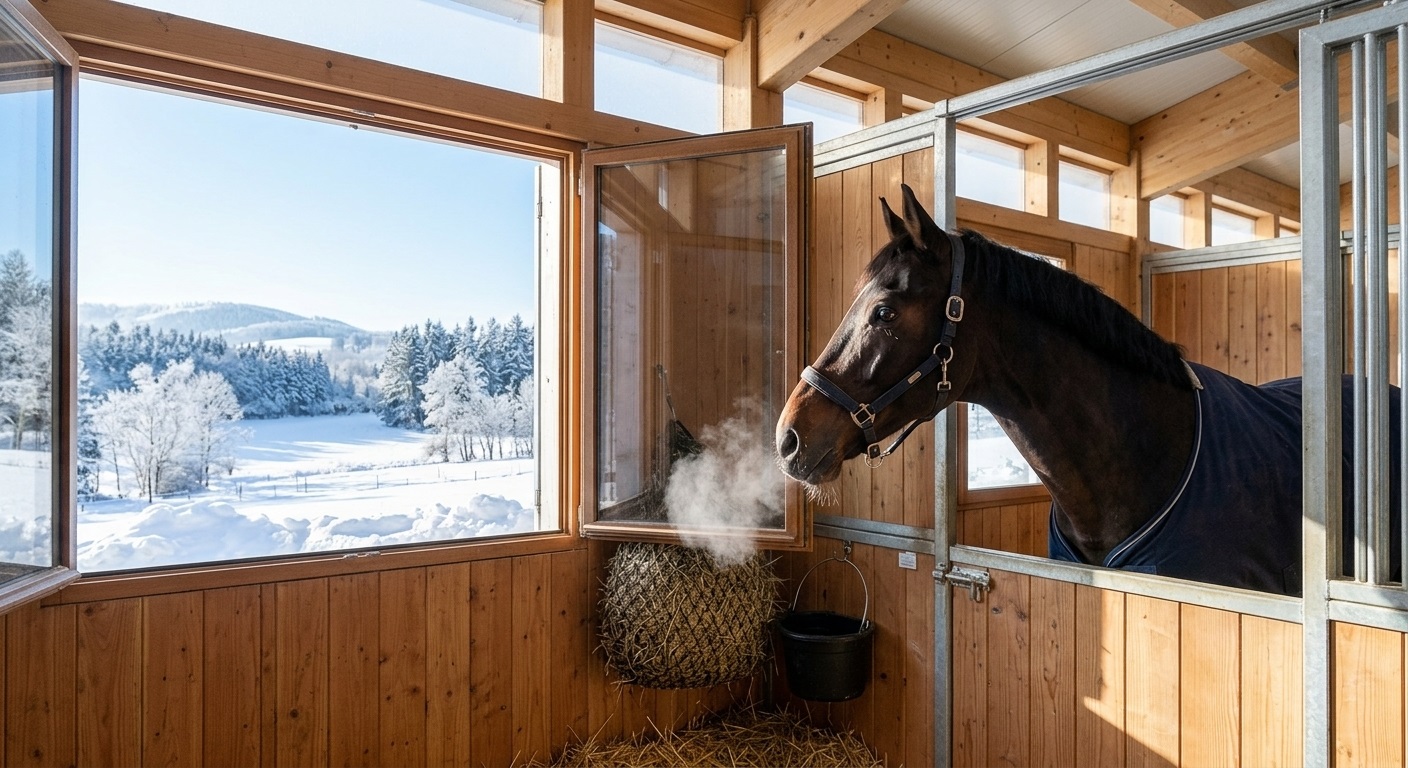
A) Current Biosecurity Gap — Airborne Exposure
Racehorses inhale approx. 100,000 L of air per day (per 500 kg horse).
That airflow routinely carries respiratory pathogens, dust-borne allergens, fungal spores, endotoxins, ammonia, and organic particulates—all contributors to:
- Lower-airway inflammation (RAO/IAD)
- Coughing / nasal discharge
- Reduced performance & recovery
- Cross-exposure during sales movements
Winter multiplies risk
Independent monitoring in the UK/EU shows indoor stable air quality can deteriorate by up to 5× in winter, driven by:
- Longer stabling hours, decreased ventilation
- Higher humidity → better pathogen survival
- Retained fine dust/particulates
- Increased viral persistence in cool, low-UV environments
Result: materially higher respiratory challenge during winter sales prep & transit.
B) Disinfectants ≠ Airspace Protection
Conventional hygiene (QACs, hydrogen peroxide, Ag-blends, detergents) provides near-term surface kill only; it does not protect the airspace where primary respiratory risk resides.
Limitations of conventional disinfectants
- Surface-only activity; non-functional in air
- Rapidly inactivated by dust/organic load
- No binding of airborne pathogens/allergens or odour VOCs
- Leaves residue concerns in live-animal settings
Duration caveat (expanded):
- QAC residues are only reliably active while wet—typically hours—and performance declines rapidly with organic matter.
- Hydrogen peroxide (incl. silver-stabilised blends) remains active for ≤ 1–2 hours, often less at typical dilutions e.g. Equine Biogenie.
- Regulatory context: under EU BPR 528/2012, efficacy is recognised under wet-contact conditions; dry-film residual claims are not accepted.
- DEFRA guidance cautions against reliance on persistent use of QAC based products combined with residues they produce in live-animal environments.
Sentinel-species exposure evidence (relevance of residues): Li / Lee / Kannan (2024) analysed 27 QACs and found:
- QACs present in indoor dust and air
- Systemic uptake in pets (urine/faeces)
- Prior detection in human plasma and breast milk
- Associations reported with respiratory issues, dermatitis, immune dysregulation, reproductive toxicity, lipid metabolism disruption
This underscores the case for minimising cationic residue films and adopting non-residual airspace control.
Bottom line: Surface disinfectants help—but only briefly, and only on surfaces. They do not protect the airspace.
C) Biofresh — The Missing Layer
Biofresh employs cucurbituril supramolecular chemistry (University of Birmingham platform) with trace silver to bind & neutralise airborne viruses, dust-allergens, fungal spores, ammonia-linked VOCs, and odours.
Key advantages
- Works in the air + on local surfaces; continues working after dry-down
- Effective across normal stable humidity/temperature
- Non-oxidising, non-corrosive, residue-light; safe in occupied stables (no PPE)
- Complements existing cleaning (not a replacement)
Protocol (when QACs are also used):
Apply QAC → allow full dry/ventilation (rinse if practical) → apply Biofresh.
Do not co-apply fresh QAC films can neutralise Biofresh’s encapsulation before action begins.
Why winter action is timely : Because stable air quality may drop up to 5× in winter, adding an airspace biosecurity layer now:
- Mitigates increased airborne load (dust/spores/viruses)
- Supports high-value horses during peak sales turnover
- Reduces irritant burden from retained dust/ammonia
Priority deployment areas
Sales-prep boxes • High-turnover/transient stabling • Arrival/quarantine barns • Transport boxes •Vetting & indoor walkways
Summary
Conventional disinfectants protect surfaces only and for short periods. Biofresh adds the missing airspace protection layer, which becomes materially more important during winter - Q4 to end of Q1 , and aligns with reduced-residue, safer-use objectives.
Reference anchors for footer/appendix
- EU BPR 528/2012 — wet-contact efficacy basis; dry-film residual claims not accepted.
- DEFRA — cautions on persistent QAC residues in live-animal settings.
- University of Birmingham (2022) — cucurbituril platform, >99.9% viral neutralisation (lab).
- Li Z-M, Lee C, Kannan K. Sci Total Environ. 2024. PMCID: PMC10932922 — QACs in indoor dust/air; systemic uptake in pets; prior detection in human plasma/breast milk; associated health concerns.
Publié le 14 nov. 2025