
The Impact of Stress on Equine Inhalation Efficiency
The Impact of Stress and Breathing on Equine Inhalation Efficiency You only want the best for your horse. So you buy a good inhaler and the finest saline solution. But what if an often-overlooked factor ruined all your efforts? That factor is your horse's breathing under stress. The widespread belief that the fine mist will somehow make its way into the lungs is unfortunately a fallacy. The truth is: successful inhalation therapy rests on two equally important pillars. If one collapses, the success of the entire treatment is compromised.
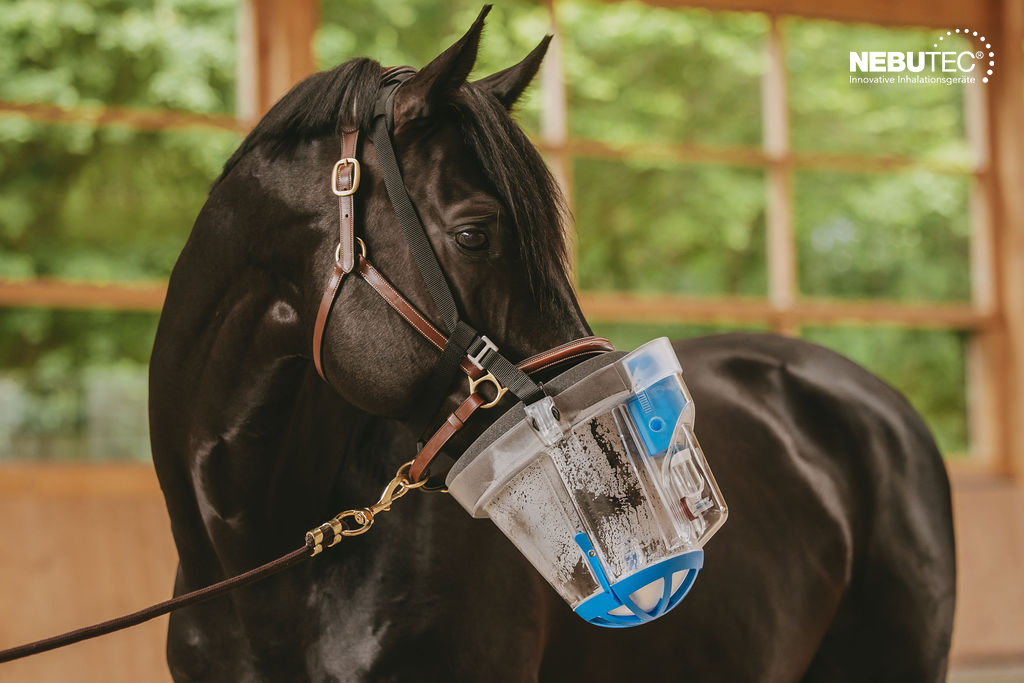
The Impact of Stress and Breathing on Equine Inhalation Efficiency
You only want the best for your horse. So you buy a good inhaler and the finest saline solution. But what if an often-overlooked factor ruined all your efforts? That factor is your horse's breathing under stress.
The widespread belief that the fine mist will somehow make its way into the lungs is unfortunately a fallacy. The truth is: successful inhalation therapy rests on two equally important pillars. If one collapses, the success of the entire treatment is compromised.
Table of Contents:
-
A Quick Look into the Lungs: Upper vs. Lower Airways
-
Stress & Breathing: The Invisible Brake on Success
-
The Two Pillars of Success: Particle Size and Breathing
-
Is All This Effort Completely Wasted Then?
-
The Solution: The Path to Stress-Free and Effective Inhalation
-
Conclusion: A Partnership for Free Breathing
1. A Quick Look into the Lungs: Upper vs. Lower Airways
Before going into detail, a quick distinction is essential. Your horse's airways are roughly divided into two areas:
-
The Upper Airways: These include the nose, pharynx (throat), and the large trachea. They act like main highways that filter and transport air.
-
The Lower Airways: These consist of the fine branches of the bronchi down to the tiny pulmonary alveoli. This is where gas exchange occurs, and it is precisely where stubborn problems like trapped mucus or inflammation related to equine asthma reside.
The goal of effective inhalation therapy is to reach these lower airways. And as we will see, that is not so simple.
2. Stress & Breathing: The Invisible Brake on Success
Horses are flight animals. A new situation, such as an inhalation mask or a loud noise, can trigger stress. Their body immediately switches into flight mode. This is an instinctive reaction preparing the body for exertion.
What happens to breathing then? It becomes fast and shallow. In medical terms, this is called tachypnea. Your horse does not just breathe faster, but also much shallower. And that is precisely where the problem lies: a shallow breath lacks the volume required to carry the mist deep into the lungs.
Imagine trying to blow a dandelion seed across a meadow. With a short, sharp burst of air, the seeds will not travel far. Only a long, gentle breath will carry them to the other side.
Breathing therefore determines where the saline solution lands in the airways — or whether it reaches them at all. Let's look at how this invisible brake neutralizes your therapy.
3. The Two Pillars of Success: Particle Size and Breathing
For the saline solution to work effectively in both the upper and lower airways, two conditions must be met. Satisfying only one of them is not enough.
1st Pillar: The Right Particle Size (The Hardware)
This is the foundation. The scientific community agrees: to reach the lower airways, particles must measure between 1 and 5 µm (micrometers).
Particles that are too large (> 5 µm) get trapped in the upper airways.
Particles that are too small (< 1 µm) are mostly just exhaled back out.
A quality nebulizer is therefore mandatory. But that is only half the battle.
2nd Pillar: The Right Breathing Pattern (The Method)
This is where breathing comes into play. Inside the lungs, two physical processes constantly determine where a particle will deposit. Your horse's breathing pattern dictates which process dominates:
-
Inertial Impaction: This process describes how particles "hit" and stick to turns in the airways. During rapid, turbulent stress breathing, airflow velocity in the upper airways is very high. Larger particles cannot follow this high speed around curves and crash into the airway wall. The upper airways thus filter out a large portion of the particles before they ever reach the lower airways.
-
Sedimentation: This process describes the slow settling of particles under the effect of gravity. This is our goal! In the fine branches of the lower airways, a calm and deep breath slows down the airflow. This gives particles within the therapeutic window (1–5 µm) enough time to gently deposit onto the mucosa and take effect. Rapid breathing deprives particles of this required time.
In summary: It is pure physics. For valuable saline particles to reach the lower airways via sedimentation, they require the slow airflow of relaxed breathing. Calm, deep breathing is therefore not merely a "nice to have," but the absolute prerequisite for inhalation therapy to work in both the upper and crucial lower airways. Particle size and breathing form a team: both must play their part.
Overview: Particle Size & Site of Action
| Particle Size (MMAD) | Primary Site of Action in Lungs | What This Means in Practice |
| > 10 µm | Upper Airways (Nose, Pharynx) | Ineffective for lower airways. Treatment is "wasted" at the top. |
| 5 – 10 µm | Upper Airways (Trachea, Main Bronchi) | Useful for upper airway mucus, but sub-optimal. |
| 1 – 5 µm (Therapeutic Window) | Lower Airways & Alveoli | Optimal! Reaches key target areas for treating asthma, etc. |
| < 1 µm | Deep Pulmonary Alveoli | Reaches the target area, but a large portion is exhaled back out. |
4. Is All This Effort Completely Wasted Then?
No, not entirely — and that is the good news. If the mist deposits its particles only in the upper airways due to shallow breathing, it still offers benefits. This is already a valuable aid for many upper airway conditions.
However: For issues located in the lower airways (such as equine asthma), this is insufficient. The primary objective — reaching the deep bronchial tree — is missed.
5. The Solution: The Path to Stress-Free and Effective Inhalation
The key to success lies in a calm, positive inhalation session. A relaxed horse breathes slowly and deeply, allowing the therapy to unleash its full potential.
Here are three tips to maximize therapeutic success:
-
Choose the Right Technology: A noisy nebulizer can be a major source of stress for your horse. Modern ultrasonic or Mesh nebulizers are virtually silent, making the experience much more pleasant for the horse.. You can also use a maskfree inhalator in the right room.
-
Smart Management and Training:
-
Habituation: Gradually introduce your horse to the mask and device using positive reinforcement.
-
Quiet Environment: Select a peaceful, familiar location for the session. The horse's own stall is often ideal.
-
Your Own Demeanor: Remain calm and relaxed yourself. Your energy directly transfers to your horse.
-
-
Apply the Right Knowledge: Armed with these insights, you can better interpret your horse's signals and create optimal conditions for successful therapy.
Conclusion: A Partnership for Free Breathing
Effective inhalation therapy goes far beyond simply strapping on a mask. It is a true partnership combining appropriate technology and compassionate management.
By providing a serene atmosphere and using the proper equipment, you give your horse the best opportunity to reap the full benefits of saline therapy and breathe freely again.
Publié le 29 juil. 2026