Aménagement d'un Espace d'Inhalation, d'Oxygénothérapie et d'Ionisation Équine /
Setting Up an Equine Inhalation, Oxygen Therapy, and Ionisation Space
Objectif : Offrir une immersion thérapeutique complète (Oxygène, Halothérapie, Ions négatifs) en totale liberté, sans masque ni contention.
1. Pourquoi Privilégier un Volume de 6 à 10 m³ ?
Le problème de la dilution dans un box standard
Dans un box classique (ex. 3 m × 3 m × 2,8 m = 25 m³), l'air diffusé par un concentrateur d'oxygène (débit maximal de 9 L/min, soit 0,54 m³/h) se dilue trop rapidement. La concentration en O₂ ambiant reste alors insuffisante pour obtenir un effet thérapeutique significatif.
L'impératif physiologique : "Zero Stress" et liberté de mouvement
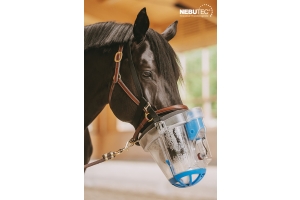
À l'inverse, confiner un cheval dans un espace trop restreint (4 à 5 m³) génère stress et claustrophobie. Un cheval anxieux adapte immédiatement sa respiration :
-
Tachypnée (respiration rapide et superficielle) : Le flux d'air devient turbulent dans les voies supérieures.
-
Phénomène d'impaction par inertie : Les particules d'aérosol et l'oxygène percutent les parois du nez et de la gorge sans jamais atteindre le fond de l'arbre bronchique.
La solution : Le volume cible optimal (6 à 10 m³)
Ce volume permet au cheval de rester debout naturally, de tourner la tête, de baisser l'encolure et de consommer son foin en toute sérénité. Calme et apaisé, le cheval adopte une respiration lente et profonde, favorisant la sédimentation profonde des agents thérapeutiques dans les alvéoles pulmonaires.
2. Équipements & Rôles Thérapeutiques
|
Équipement |
Spécifications Techniques |
Rôle & Bénéfice Santé |
|---|---|---|
|
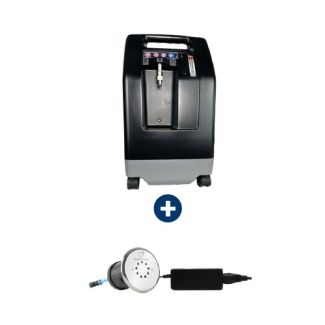
Concentrateur d'Oxygène Exclusive 9L |
Débit réglable jusqu'à 9 L/min. Concentration en O₂ : 90 % à 93 %. |
Enrichit l'air ambiant en oxygène purifié pour stimuler le métabolisme cellulaire, réduire le stress oxydatif et accélérer la récupération. |
|
Module d'Ionisation Oxygenconcept |
Compact (15 cm de haut), alimentation 12 V, très faible consommation (1 W). |
Injecte une forte densité d'ions négatifs pour neutraliser et faire tomber au sol les poussières, allergènes et germes en suspension. |
3. Recommandations d'Aménagement & Matériaux
3.1 Dimensions recommandées
-
Volume optimal : 6 à 10 m³
-
Dimensions types : Longueur 2,2 à 2,5 m | Largeur 1,5 à 1,8 m | Hauteur 2,0 à 2,2 m.
-
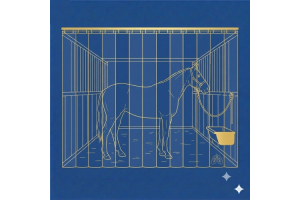
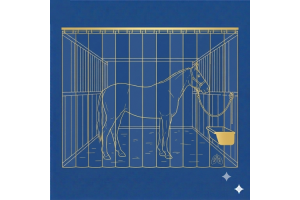
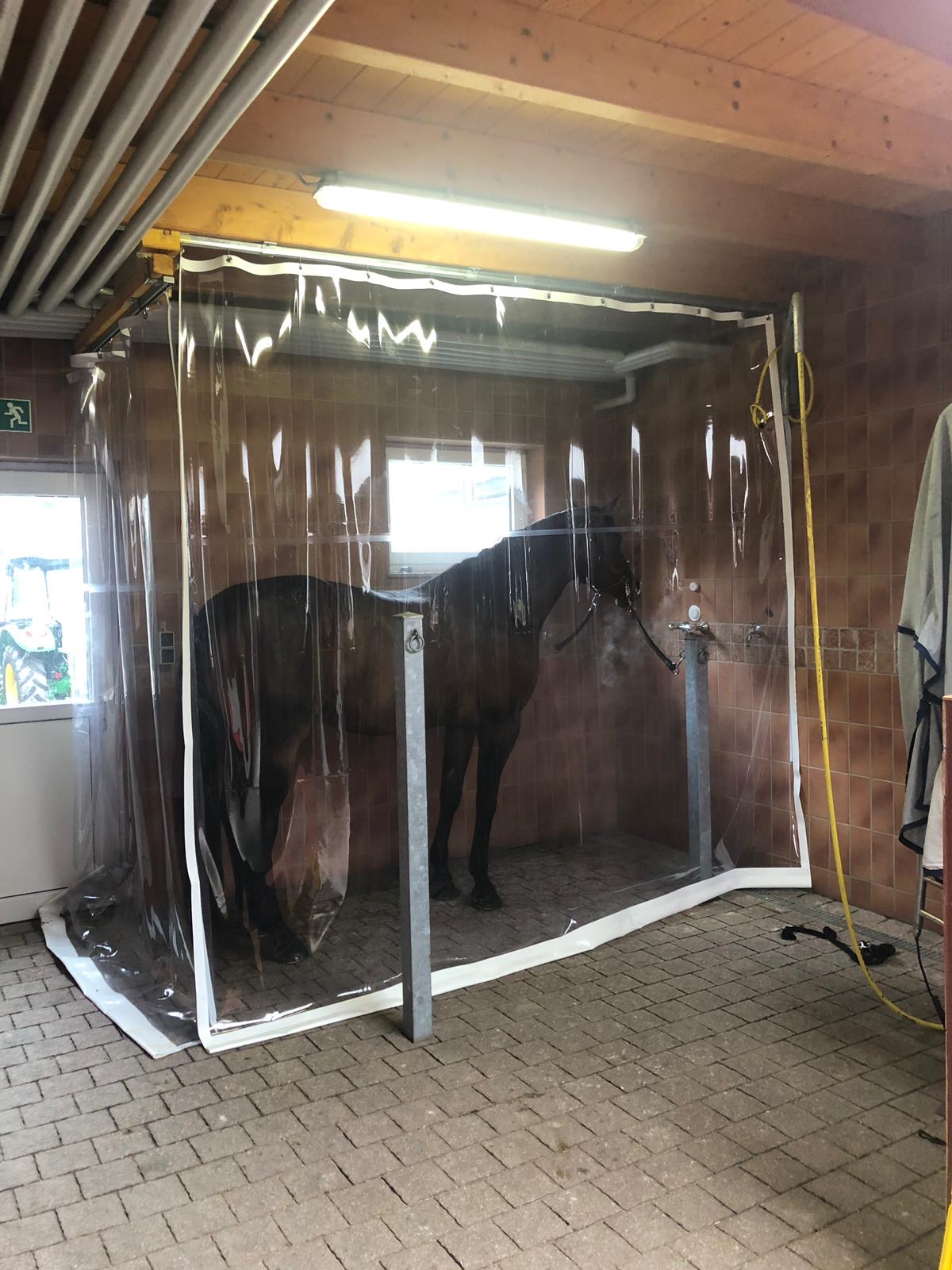
Adaptation d'un box existant : Installer une cloison amovible ou une séparation rigide étanche (panneaux PVC ou bâche lourde transparente) pour créer la zone de soin dédiée au sein du box.
3.2 Choix des matériaux
-
Parois et cloisons : Privilégier des panneaux sandwich isolants, des plaques en PVC lisse ou de la résine. Éviter le bois brut poreux, qui retient l'humidité et favorise le développement de moisissures.
-
Contact visuel & Luminosité : Intégrer une large baie vitrée ou une paroi transparente en polycarbonate à hauteur d'œil. Garder une vue sur l'écurie ou le soigneur est essentiel pour rassurer le cheval.
-
Sol : Caoutchouc antidérapant et lavable, avec joints étanches sur le pourtour pour simplifier le nettoyage.
4. Consignes de Fonctionnement, Sécurité & Hygiène
-
Réglage du concentrateur : Régler l'appareil sur 9 L/min (débit maximal) pour assurer un enrichissement rapide de l'air ambiant.
-
Évacuation du CO₂ : Le dioxyde de carbone rejeté par le cheval étant plus lourd que l'air, installer une grille d'évacuation passive en partie basse de l'un des murs.
-
Emplacement des appareils : Placer le concentrateur d'oxygène et les branchements électriques à l'extérieur de la cabine, dans un endroit sec et ventilé.
-
Positionnement de l'ioniseur : Placer le module à proximité de la zone respiratoire du cheval (près du point d'injection d'air).
-
Désinfection entre deux chevaux (Biofresh®) : Pulvériser la solution Biofresh® sur les parois et le sol entre chaque séance. Ce protocole élimine les germes et neutralise biologiquement les odeurs (notamment l'ammoniac) sans dégager de vapeurs chimiques agressives.
5. Synthèse Opérationnelle
-
Volume de la cabine : 6 m³ à 10 m³ (Espace zéro stress, sans contention)
-
Débit d'oxygène : 9 L/min (En continu)
-
Durée de séance : 30 à 45 minutes par session
-
Environnement : Foin à disposition, paroi transparente, éclairage doux
-
Hygiène : Pulvérisation de Biofresh® entre chaque passage + nettoyage régulier des filtres à air
Setting Up an Equine Inhalation, Oxygen Therapy, and Ionisation Space
Author: Dr Bernard Stoffel — Equandlab.com
Objective: Provide a complete therapeutic immersion (Oxygen, Halotherapy, Negative Ions) in full freedom, without masks or restraint.
1. Why Favor a Volume of 6 to 10 m³?
The Dilution Problem in a Standard Stall
In a traditional box stall (e.g., 3 m × 3 m × 2.8 m = 25 m³), air supplied by an oxygen concentrator (maximum flow rate of 9 L/min, i.e., 0.54 m³/h) dilutes too rapidly. The ambient O₂ concentration remains insufficient to achieve a significant therapeutic effect.
The Physiological Imperative: "Zero Stress" and Freedom of Movement
Conversely, confining a horse in an excessively restricted space (4 to 5 m³) generates stress and claustrophobia. An anxious horse immediately alters its breathing pattern:
-
Tachypnea (rapid, shallow breathing): Airflow becomes turbulent in the upper respiratory tract.
-
Inertial Impaction Phenomenon: Aerosol particles and oxygen collide with the walls of the nose and throat without ever reaching the deep bronchial tree.
The Solution: The Optimal Target Volume (6 to 10 m³)
This volume allows the horse to stand naturally, turn its head, lower its neck, and consume its hay in total serenity. Calm and relaxed, the horse adopts a slow and deep breathing pattern, promoting deep sedimentation of therapeutic agents into the pulmonary alveoli.
2. Equipment & Therapeutic Roles
|
Equipment |
Technical Specifications |
Health Role & Benefits |
|---|---|---|
|
Exclusive 9L Oxygen Concentrator |
Adjustable flow rate up to 9 L/min. O₂ concentration: 90% to 93%. |
Enriches ambient air with purified oxygen to boost cellular metabolism, reduce oxidative stress, and accelerate recovery. |
|
Oxygenconcept Ionisation Module |
Compact (15 cm high), 12 V power supply, ultra-low power consumption (1 W). |
Injects a high density of negative ions to neutralize airborne dust, allergens, and germs, precipitating them to the ground. |
3. Layout Recommendations & Materials
3.1 Recommended Dimensions
-
Optimal Volume: 6 to 10 m³
-
Typical Dimensions: Length 2.2 to 2.5 m | Width 1.5 to 1.8 m | Height 2.0 to 2.2 m.
-
Adapting an Existing Stall: Install a removable partition or rigid airtight separation (PVC panels or heavy transparent canvas) to create a dedicated treatment area within the box stall.
3.2 Material Selection
-
Walls and Partitions: Favor insulated sandwich panels, smooth PVC sheets, or resin. Imperatively avoid raw, porous wood, which absorbs moisture and promotes mold growth.
-
Visual Contact & Brightness: Integrate a large glass window or transparent polycarbonate wall at eye level. Maintaining a clear line of sight to the stable aisle or handler is essential for reassuring the horse.
-
Flooring: Non-slip, washable rubber flooring with sealed perimeter joints for easy cleaning and sanitization.
4. Operating Guidelines, Safety & Hygiene
-
Concentrator Setting: Set the unit to 9 L/min (maximum flow rate) to ensure rapid enrichment of the ambient air.
-
CO₂ Evacuation: Carbon dioxide exhaled by the horse is heavier than air. Install a passive exhaust vent at the bottom section of one wall.
-
Equipment Placement: Keep the oxygen concentrator and electrical connections outside the booth in a dry, well-ventilated area.
-
Ioniser Positioning: Place the module near the horse's breathing zone (close to the air injection point).
-
Disinfection Between Horses (Biofresh®): Spray Biofresh® solution on walls and flooring between each session. This protocol eliminates germs and biologically neutralizes odors (especially ammonia) without emitting harsh chemical fumes.
5. Operational Summary
-
Cabin Volume: 6 m³ to 10 m³ (Zero-stress environment, hands-free / mask-free)
-
Oxygen Flow Rate: 9 L/min (Continuous)
-
Session Duration: 30 to 45 minutes per session
-
Environment: Access to hay, transparent partition, soft lighting
-
Hygiene: Biofresh® spray application between passes + regular cleaning of air filters
Equandlab.com — Technical support and equine performance expertise